Bringing Human-Centered Design to the Skies
Roaa Marei (EDI ‘27) spent last year as a Fellow with the Abrams Climate Academy, allowing her to understand and help alleviate the environmental impacts of air travel.
Roaa Marei (EDI ‘27) is on a mission to make air travel more environmentally friendly.
This past year, she served as a Fellow with the Abrams Climate Academy, an on-campus program that connects graduate students across Northwestern while providing a space to drive innovative solutions to the climate crisis.
“I have always been interested in aerospace and aviation,” said Roaa, who came to Northwestern's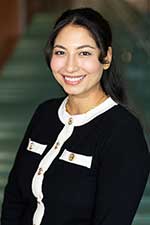 Master of Science in Engineering Design Innovation (EDI) program after earning a bachelor’s degree in mechanical engineering from Harvard and working with aerospace manufacturing company Woodward. “Through my engineering coursework and my work, I saw how challenging decarbonization can be in industries like aviation.”
That’s because aircraft require enormous amounts of energy to bolt skyward—and stay there. So far, few simple alternatives to traditional jet fuel have been found. The result is that the global aviation industry itself is responsible for about 3.5 percent of human-caused global climate change, according to National Oceanic and Atmospheric Administration (NOAA) research. Its carbon dioxide emissions account for roughly 2 percent of the global total, while non-CO2 effects such as persistent contrail cirrus clouds, nitrogen oxides, and soot trap heat. This roughly doubles the sector’s net warming impact, NOAA research found.
The Abrams Climate Academy is a selective year-long experiential learning program that provides students with a toolkit for leading climate action within an organization. Students from the Kellogg School of Management, the McCormick School of Engineering, the Northwestern Pritzker School of Law, the Medill School of Journalism, Media, Integrated Marketing Communications, and affiliated with the Paula M. Trienens Institute for Sustainability and Energy learn to tackle climate challenges alongside industry partners.
“I first learned about the Abrams Climate Academy through an email, and I remember feeling excited about it almost immediately,” she said. “I knew right away that I wanted to apply, even before I had officially arrived on campus.”
Roaa partnered with LanzaJet, a sustainable fuels technology company that developed the world’s first commercial-scale alcohol-to-jetfuel biorefinery.
She quickly saw how what she was learning in EDI could be applied to her LanzaJet work.
“EDI taught me how to approach complex problems by first understanding the people, systems, and stakeholders involved rather than immediately jumping to a solution,” she said. “I applied methods such as stakeholder interviews, synthesis, systems thinking, iterative problem framing, and storytelling throughout the LanzaJet project.”
The fellowship also expanded Roaa’s international experience. Through the fellowship, she traveled to Geneva, Switzerland, for the Roundtable on Sustainable Biomaterials conference. There, she networked with professionals from around the world working in sustainable fuels, agriculture, policy, certification, and climate finance.
Roaa plans to work as a systems engineer in a role that allows her to combine her background in mechanical engineering with the design, innovation, and human-centered problem-solving skills she is learning in EDI.
She said she is especially interested in working with interdisciplinary teams similar to what she found in the academy.
“EDI helped me strengthen my ability to combine engineering with human-centered design, product strategy, and communication. The Abrams Climate Academy helped me understand the business and policy considerations that influence whether an innovative technology is adopted,” she said. “Together, the programs have helped me become a more well-rounded engineer and problem solver.”