
Designing for Imagination with Real-World Constraints
Northwestern Engineering students designed a Peter Rabbit–themed letter-writing station for the Morton Arboretum's Children's Garden through an open-ended DTC class challenge.
 On the first day of fall quarter in 2025, Bridget Brown (‘29) and her team in Design Thinking and Communication (DTC) were given an unusually open-ended challenge: design a space that would be engaging, accessible, and educational within a whimsical storybook aesthetic.
The prompt asked students to create a Peter Rabbit-themed letter-writing station for the Morton Arboretum’s addition to the Children’s Garden. Set to open in summer 2026 and be further developed for the next two or three years, the space would foster early literacy through playful, story-centered experiences. How that vision would take shape, though, was left largely up to the students.
“We were starting from a very basic idea that could go in any direction, so there was a lot of imagination when it came to designing the aesthetic and the space,” Brown said.
As the team of first-year Northwestern Engineering students, consisting of Brown, Graham Gilbert-Schroeer, Fares Khalil, and Safiya Mohamed, continued to move through the design process, abstract questions turned into concrete ideas. The station needed to withstand outdoor conditions, remain accessible to children of all abilities, and invite creativity for users. These parameters presented Brown and her team with a complex, human-centered design problem they solved with empathy and imagination.
Defining the problem
For Emilian Geczi, the Senior Manager of Early Learning at the Arboretum, the addition of the writing station was part of a bigger mission to encourage literacy in a space that already draws significant community engagement.
“The Children's Garden is a place where families come together to explore, discover, and learn through nature,” Geczi said. “As part of my role in early learning, I'm always thinking about how we can create experiences that support children’s development while making it easy and engaging for families to participate.”
The Arboretum was already planning on including a little library, where guests can take and read copies of The Tale of Peter Rabbit by Beatrix Potter to promote early literacy.
Having already teamed up with the DTC program twice before, the Arboretum tasked student groups in the class to use the little library concept as a starting point to expand that initiative to promote both reading and writing.
Doing some digging
Teams could either design one high-fidelity prototype of a single element of the letter-writing station, or low-fidelity prototypes of the entire station. Brown’s team, flush with ideas, chose the latter.
About a week later, the team met with Geczi to talk more about the expectations for the space.
“What we like about the DTC program is that it looks at projects from angles we might not have even conceived of, and it asks us great questions,” Geczi said. “As the students try to get a good sense of what we're looking for, it forces us to clarify our goals and our requirements.”
Those questions ranged from big-picture considerations, like which age groups the station should serve, to specific logistical concerns such as how a visitor using a wheelchair would navigate the space and access the installation.
To answer them, Brown and her team went on a field trip to the Arboretum. While on the trip, the team did more than just observe the space as designers – they also explored it as if they were children, putting themselves in the shoes of the users to identify their wants and needs.
“We saw that there’s currently a vegetable garden there, so we thought, ‘What if we prompt the kids to write Peter Rabbit about what they saw in the garden? Or which vegetables were their favorites?’” Brown said.
Planting the seeds
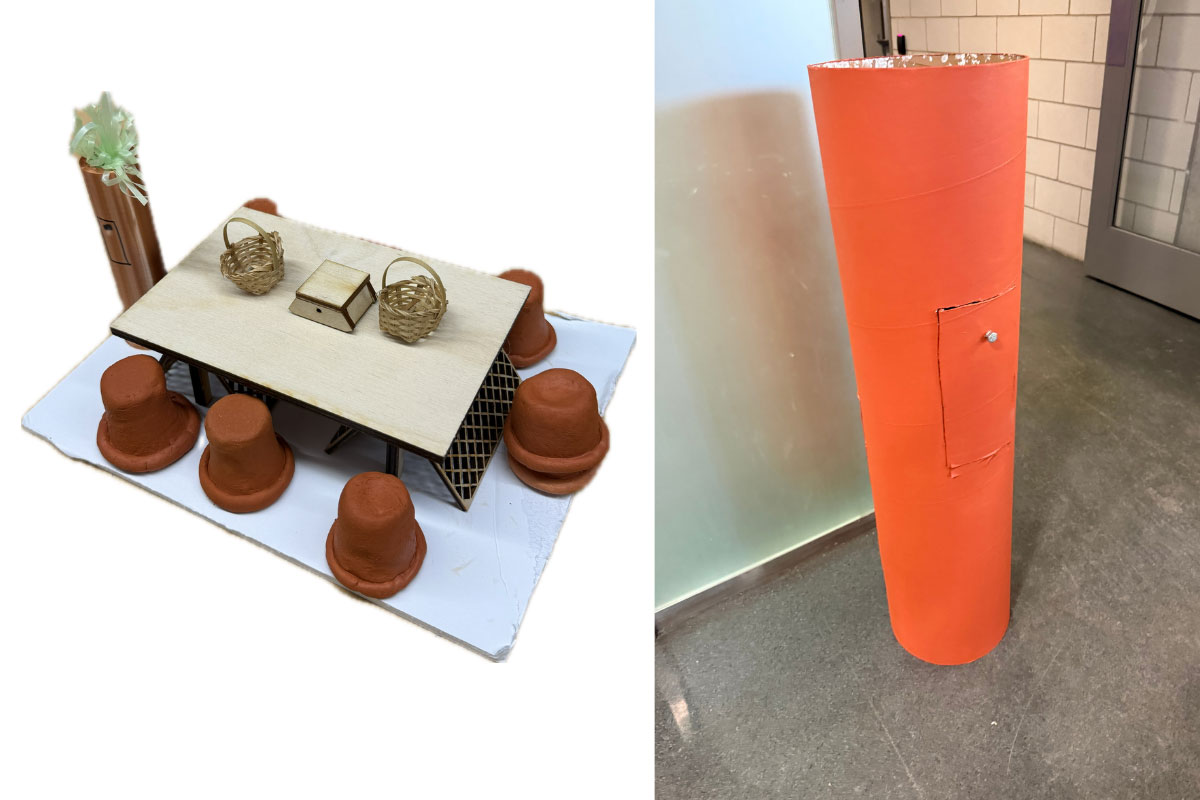
After the visit, the team began translating their research and observations into tangible prototypes. They designed a table with legs modeled after cucumber trellises, paired with stools shaped like overturned flower plots to blend in with the garden environment.
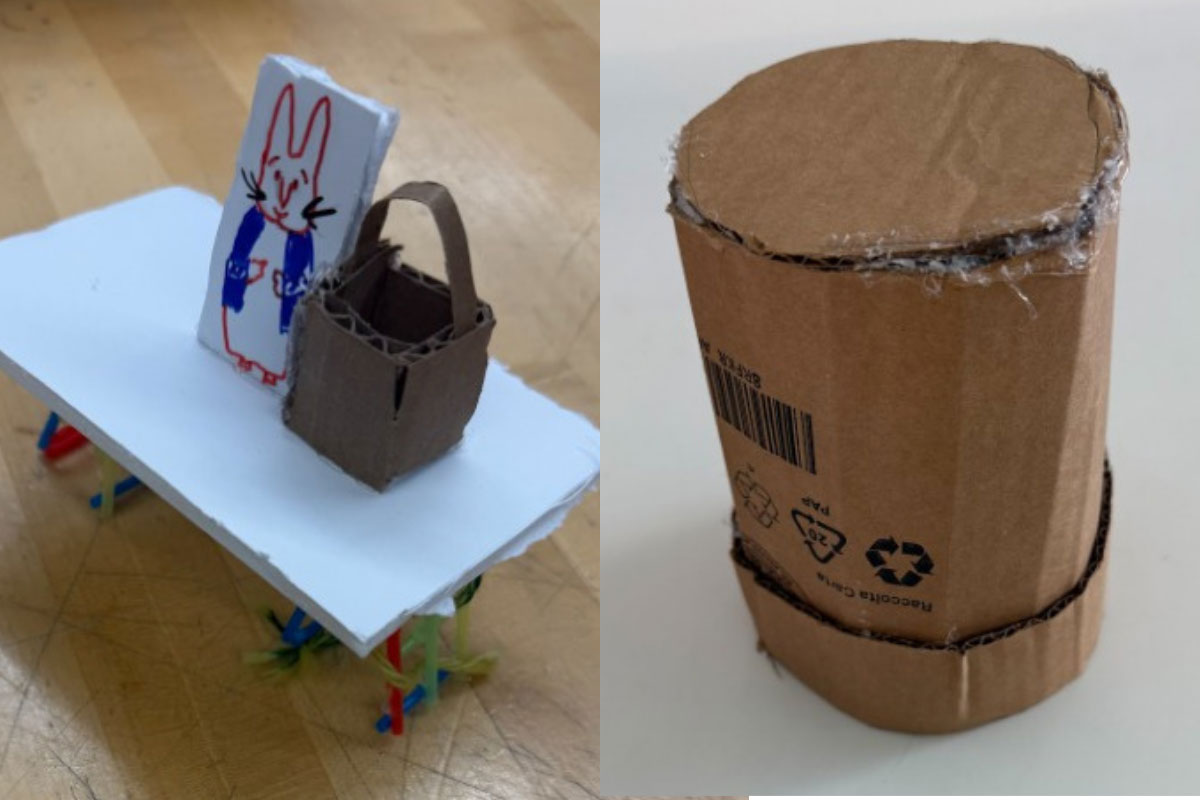 They designed a box that dispenses one piece of paper at a time for children, as well as wicker baskets to hold writing utensils suitable for a range of ages. The paper itself was designed to double as a learning tool – lined on one side for writing and formatted like the address line of a letter; and on the other, it served to introduce children to the postal system. The team also created wooden boards with writing prompts engraved on them to encourage children to reflect on what they saw and experienced.
After writing their letter at the station, children can send their mail to Peter Rabbit through the mailbox, which the team modeled to look like a British Royal Mail Postbox to honor Peter Rabbit’s home country.
When the students presented their final prototypes in December of 2025 at the DTC Expo, the representatives from the Arboretum were so impressed with the team’s work that they put everything they could fit into the trunk of their car to use as they develop the Peter Rabbit-themed installation.
The Arboretum was so pleased with all of the class’s designs that they took all of the prototypes with them,” DTC instructor Kevin Kappock said. “That’s rare.”
For Brown, the project ultimately reshaped how she thinks about how to tackle the creative side of engineering problems.
“A lot of people come into an engineering degree thinking it's just solving math problems and following instructions to build things,” she said. “But a lot of time, there isn't an answer, and there aren't instructions, so you have to use your imagination and be creative when coming up with solutions to problems.”
As the Children’s Garden continues to develop, the letter-writing station will stand as a testament that a creative mindset has the capability to make change.
“When we looked at the numbers for how many visitors the Arboretum gets, we realized just how many lives this project would touch and how many kids would interact with this project and hopefully find joy from the experience,” Brown said. “It definitely felt like an impactful project.”