
Designing Common Ground
A novel campus collaboration between the Segal Design Institute and Northwestern’s Litowitz Center for Enlightened Disagreement puts addressing conflict in play.
Victoria Jewell (’29) spent a lot of time thinking about board games and disagreement last spring.
In a Design Thinking and Communication (DTC)-2 course, she observed teens playing board games and researched board game design, including how game designers consider the needs of people who have visual, auditory, physical, or cognitive disabilities. At the same time, she examined how conflicting ideas and opinions stirred division and undermined the pursuit of constructive discussion.
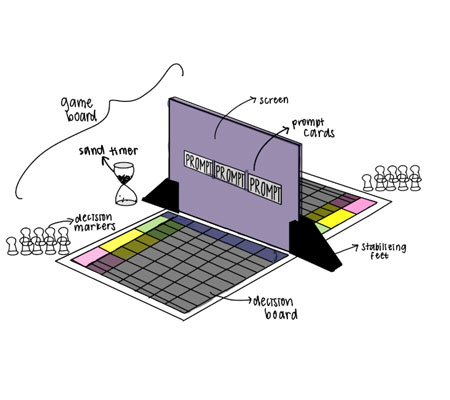
Jewell’s exploration alongside a team of fellow Northwestern Engineering first-year students sparked the development of Synced. Created for the high school classroom, the board game encourages players to ask questions about each other’s beliefs and preferences to nurture thoughtful and respectful disagreement.
Last spring, four student teams across two DTC-2 sections developed games to promote enlightened disagreement in an accessible, disarming, even enjoyable way. Veteran DTC program instructors John Anderson and Janice Mejia co-taught the courses.
“This was an opportunity for students to strengthen their craft as human-centered designers while also thinking deeply about communicating with people more effectively, including those we might disagree with,” said Anderson, who has taught in the DTC program since its beginnings.
Building a new partnership
Exploring game design and disagreement might seem an odd turn for an environmental engineering major like Jewell and the Segal Design Institute’s foundational DTC course, but that’s actually the point of a new partnership between Segal and the Litowitz Center for Enlightened Disagreement at Northwestern.
The Litowitz Center originally launched as a research entity at Northwestern’s Kellogg School of Management in 2024. The following year, Northwestern University Trustee Jennifer Leischner Litowitz (’91) and Alec Litowitz (’22, ’27 P) pledged $20 million to elevate the upstart center’s work as well as the University’s impact on championing constructive engagement across difference. The Litowitzes’ generosity created today’s University-wide center with research, outreach, convening, and curriculum central to its mission.
Having been at Northwestern for 18 years, Litowitz Center curriculum director Brad Zakarin was familiar with DTC and wondered if students might create a suite of youth-focused products to promote enlightened disagreement.
“I thought they’d be uniquely positioned to do so,” Zakarin said of DTC students.
Zakarin pitched the idea to Segal leadership and found an open-minded partner eager to stretch students’ minds. Within months, DTC-2 students were designing games to cultivate teens’ enlightened disagreement skills.
As the students’ project partner, the Litowitz Center helped students navigate a specialized and nuanced design challenge. Zakarin, for instance, introduced tenets of enlightened disagreement to students while also providing resources and organizing game nights to test prototypes.
 As students developed their ideas, Mejia observed something interesting. Students were “living the subject matter,” navigating diverse thoughts to advance their respective projects.
“Their own disagreements became part of the learning process,” Mejia said.
For DTC-2 student Thy Bui (’29), the challenge of designing a lively game to encourage enlightened disagreement proved particularly energizing. It mixed aspects of psychology, emotions, and strategy with traditional human-centered design skills like research, prototyping, and iteration.
“At first, it was difficult to work on a project that was heavily conceptual and theoretical in a class that pounds on progress,” said Bui, an industrial engineering major and, like Jewell, a member of the Synced team. “In the end, though, we could see how much we grew from our original ideas.”
Growing collaborative momentum
Zakarin and his Litowitz Center colleagues were impressed by all four projects produced last spring, from their approach to gameplay to the skills games emphasized. So much, in fact, center leadership plans to leverage an internal innovation fund to fuse elements of two projects into one game. This fall, the center invited members of those original DTC-2 teams to participate in the blended game’s continued development.
“We want to hear what young people have to say and creatively engage with them,” Zakarin said, adding that some of last spring’s DTC-2 students, including Jewell and Bui, enrolled in the Litowitz’s residential certificate program in enlightened disagreement for the 2026-2027 academic year.
Moving forward, leaders at both Segal and the Litowitz Center look to expand their collaboration. Next spring, Segal has committed to partnering with the Litowitz Center again—this time, issuing the enlightened disagreement game design challenge to eight teams across four DTC-2 sections.
“I’m eager to see the good ideas this next group creates,” Zakarin said, calling the potential of developing a game deployed in high school classrooms “the ultimate win-win-win” highlighting Northwestern, DTC, and the Litowitz Center.
Anderson is similarly excited about extending Segal’s collaboration with the Litowitz Center.
“We love repeat business because you get better at working together the more you do it,” Anderson said. “Even more, this is a campus partner pushing our students to think about disagreement as something that can be constructive, productive, and instrumental to progress.”