
Beyond the Umbrella Stand
How a team of first-year Northwestern Engineering students solved a long-simmering and cumbersome problem for Misericordia.
For years, Alaina Cody and her co-workers at Misericordia, a Chicago-based organization supporting individuals with intellectual and developmental disabilities, faced a pesky problem. Their existing makeshift solution, a metal umbrella stand, was no longer a serviceable one.
Whenever Cody (‘20) or a colleague removed a specialized mounting pole holding an Augmentative and Alternative Communication device from a speech-impaired resident’s wheelchair, they had no effective way to store the oddly shaped poles. The umbrella stand was their go-to option, but the poles’ irregular shapes and uneven weight distribution often caused the umbrella stand to tumble, thereby creating a tripping hazard for residents and staff. Yet more, staff often struggled to insert and remove the poles from the umbrella stand.
So, Cody, a speech-language pathologist in the Misericordia Home Therapy Department, turned to her alma mater for a solution. She presented her problem to a Design Thinking and Communication (DTC) class – the two-quarter course required of all first-year Northwestern Engineering students – and challenged the young innovators to design a new storage solution delivering safety and convenience.
One team’s path to a solution
Across the first half of the 2025-2026 academic year, the DTC team of Aviva Laegeler, Rolando Vela, Grace Niu, and Yao Xiao tackled Cody’s challenge with enthusiasm and purpose.
 The four-member group interviewed Cody and visited Misericordia to learn more about context and user needs. They reviewed scholarly articles, brainstormed potential solutions, and crafted mockups for Cody’s review, eventually deciding to pursue a design rooted in modular components. After researching production methods and collecting feedback from DTC classmates and instructors Shuwen Li and Ken Gentry, the team constructed its solution in the shop, gaining experience with technologies like 3D printing and laser cutting as well as equipment like band saws and a CNC router.
“Everyone in our four-person group was fully invested in the project, and—perhaps by luck—we each brought unique skills that complemented one another,” said Xiao, an electrical engineering student.
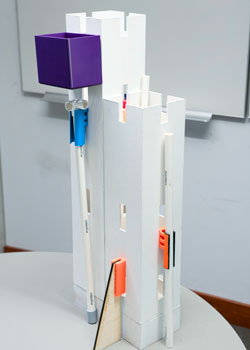
The collaborative energy spurred a novel solution: Grasshopper is a cost-effective, modular storage unit delivering stability and ease of use to solve Misericordia’s long-festering problem.
Grasshopper features a series of canisters constructed of plywood. The canisters can be connected and disconnected much like LEGO bricks to build universally compatible configurations. In addition, 3D-printed clamps slide onto the canisters to ensure easy storage and removal of the irregularly shaped poles.
Cody called the Grasshopper solution a safe, organized method for storing the specialized therapy equipment. She said the DTC team thoughtfully considered the needs of Misericordia residents and staff—a foundational element of the human-centered design principles students learn in the DTC course.
“Students were deeply engaged with Misericordia’s mission of empowering our residents to have access to opportunities and equipment that enables them to participate to the fullest in everyday life,” Cody said.
Reflecting on a dynamic experience
Before enrolling in DTC, Laegeler said she had no experience working on a team project with other engineers, much less partaking in a group effort defined by collective excitement and engagement. The collaborative environment and practice of using human-centered design to address an irksome problem for Misericordia intensified Laegeler’s interest in engineering. It also provided a litany of skills and lessons she believes will be valuable in the years ahead, from dimensioning drawings to navigating group dynamics to ordering information in search of a solution.
“While I will use math, chemistry, coding, and linear algebra to solve problems in my career, the way I will research beforehand, document the problem solving, and work with a team to arrive at a solution has so far only been covered in Professor Li and Professor Gentry’s classroom,” said Laegeler, a first-year student studying materials science and engineering and art, theory, and practice.
Xiao, too, appreciated DTC’s collaborative approach, working alongside his engineering peers while simultaneously receiving steady mentorship from Li and Gentry.
“The DTC class not only gave me three close friends but also showed me the power of teamwork in engineering, enabling us to create something that would have been hard for any of us to accomplish alone,” he said.
Xiao added that tackling a real-world project from a mission-oriented client like Misericordia provided an important window into the realities of the professional engineering world, including process, limitations, and expectations.
“DTC gave me a real taste of what working on an engineering project is like, from how an engineering project timeline unfolds to how to talk to the project partners,” he said. “It was a very comprehensive experience.”