
SureThing Solves a Messy Problem
Northwestern students design a simple device making diagnostic urine collection easier, cleaner, and more reliable for patients and clinicians.
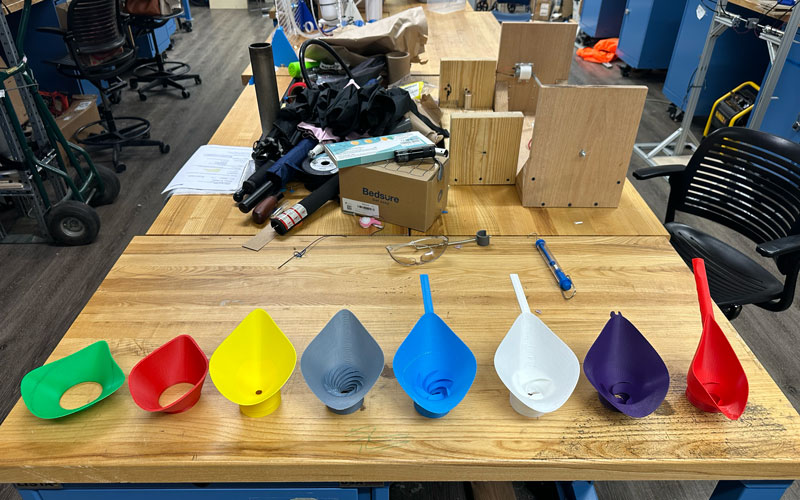
When a team of six Northwestern students presented their idea for a redesigned diagnostic urine collection experience to Emily Jungheim, the Chief of Reproductive Endocrinology and Infertility in the Department of Obstetrics and Gynecology at Northwestern Medicine, she was intrigued.
In the latter stages of pregnancy, women can face difficulties providing a clean-catch specimen for urine analysis, as limited mobility can create an awkward endeavor. The issue can extend to women with other physical challenges. Those challenges heighten the risk of sample contamination, which weakens diagnostic accuracy and triggers repeat testing, increasing both costs and medical waste.
The students were enrolled in the Segal Design Institute’s Manufacturing and Design Engineering (MaDE) capstone course. In their presentation, they shared a compelling and creative alternative to deliver a more comfortable and reliable urine sample collection experience: a funnel-like handheld device that automatically separates midstream urine to reduce the risk of contamination.
“These were smart students creating a neat, usable, and practical product I could definitely see working in the clinic or for at-home collection,” said Jungheim.
Empowered to innovate
Ironically, the MaDE student team—Sabrina Araya, Benjy Braunstein, Dalia Diab, Alyssa Frederick, Ryan Murphy, and Taewon Yoon—initially targeted an improved urine collection experience not for clinical applications but to streamline drug testing, something many college students encounter with employment or athletics. As the group researched drug testing, however, they discovered the same problems—a cumbersome experience and frequently contaminated results—hampered medical environments.
“No matter where it takes place, urine collection just isn’t a human-centered experience,” said Diab, a senior MaDE major.
 The team pivoted from its drug testing applications to reimagine urine collection for medical testing, a much larger market and one where a potential solution promised broader impact. They envisioned creating a more comfortable, friendly, and effective user experience and an alternative to the two prevailing methods: plastic urine collection cups, which were inexpensive yet messy and fraught with contaminated results, and catheters, which provided accuracy but were costly and invasive.
After meeting with clinicians to validate the problem, the six-member team brainstormed potential solutions. The group examined several ways to make clean, midstream collection easier. They reviewed patents that trapped liquid or diverted liquid flow into distinct areas.
“The great thing about Segal is that it promotes ambitious, creative ideas, so we felt empowered to develop this and to continue exploring,” Diab said.
A cleaner catch
The MaDE group’s relentless inquiry, iteration, and testing resulted in SureThing.
The handheld midstream urine separator interfaces with the ubiquitous collection cup and captures the initial 25 milliliters of a continuous urine stream. Thereafter, an absorbent material pushes a buoyant plug upward and funnels all additional urine directly into the collection cup. Users can then easily detach the cup from SureThing and twist on a cap for analysis submission.
“That’s exactly the clean sample you want,” Diab said.
In reimagining the urine collection experience, the group modernized a clunky clinical experience and put patient comfort and an uncompromised sample at the center of their efforts. As a result, they devised a solution providers could seamlessly integrate into existing workflows and individuals could intuitively deploy for at-home testing.
“I see this as a real boon for my patients and something that can help everyone have a more straightforward and positive experience,” Jungheim said.
In the final stages of the MaDE capstone course, the SureThing team crafted a commercialization plan and filed a provisional patent. They are interested in partnering with a medical supply company and exploring licensing opportunities for their novel concept.
“As a team, we’re proud of the work we’ve done and see the potential of our idea to impact people’s lives, which is incredibly exciting,” Diab said.