
The Human Element of Big-Tire Manufacturing
Vikram Raju (MMM '16) watched many of his MMM classmates pursue careers in product management, but he's found clear ways to apply lessons learned in the program to finance and operations, especially in his current role as vice president and CFO of Michelin Global Mining.
Dramatic music plays in the background as a miner approaches a heavy-duty truck they'll drive into a quarry. The woman stops and stares at the truck's massive tires — easily over 10 feet tall.
That scene is from a marketing video for tire manufacturer Michelin. Like that miner, most people are awestruck by the size of these tires. When Vikram Raju (MMM '16) looks at them, he sees an improved human experience.
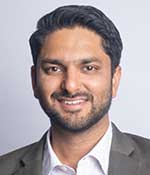
“One thing that I’ve come to appreciate about tire production is that it isn’t just about incredible technical innovation, it’s also incredibly human,” said Raju, vice president and chief financial officer (CFO) of Michelin Global Mining. “Tires must improve safety, they must be part of a holistic solution to improve productivity, and the materials in them need to be both sustainably sourced and recovered wherever possible.”
Raju credits his appreciation for the human-centered approach to his time in Northwestern's MBA + MS Design Innovation (MMM) program — a dual-degree program between Northwestern Engineering and the Kellogg School of Management.
One of the MMM program’s main focuses is human-centered design. The approach stresses the importance of understanding the end user, including their needs and pain points, before developing a product.
In his current role, Raju focuses on users all over the world.
"Our job in finance is to drive collective clarity and confidence in the choices that we're making to support growth in and operational excellence in the business," said Raju, who has been promoted twice since he joined Michelin in 2023. "One of the incredible things about MMM is we learned to always consider the people component and the role that plays in making solid business decisions. That intellectual flexibility is really important, and being able to engage that has been exciting."
Raju went into consulting after graduating from MMM and then focused on growth at a tech startup. He saw many of his MMM classmates take the lessons they learned and apply them to product management roles, but he realized he was being drawn down a path: finance and operational excellence.
He knew that route was less common for MMM graduates, but he quickly saw how what he learned in the classroom would still be directly applicable to his work.
“In most large organizations, interacting with a finance team is like, ‘Oh, here come the number wonks,’” he said. “But you can make the numbers a human experience too. If people in the organization feel super comfortable with the numbers, feel energized by building a business case that makes economic sense, you all of a sudden enable teams to collaborate more seamlessly.”
Raju spent more than a year as CFO of an AI software company before joining Michelin. He was vice president and CFO of Michelin Connected Fleet North America, then president and chief operating officer of Michelin Mobility Intelligence before taking on his current role in June.
One of his primary interests right now is circularity and identifying how to reuse the core ingredients in tires once they are done being used. To understand the best options, he finds himself turning once again to MMM.
"There's absolutely an economic component to the problem, the math has to make sense," he said. "But there's also a deeply human component. You can go to a mine site or a junkyard and see piles of used tires everywhere."
As he strives to help Michelin achieve its sustainability ambitions, Raju continues to consider human-centered design. What are the pain points MIchelin's customers and communities have, and how can he and his company offer services that address those challenges?
Those questions are central to his job and the jobs of many of his MMM classmates.
“MMM has sent a lot of students to product management roles and tech roles, and I absolutely see the consistency there,” Raju said. “But what MMM really gives you is a way of thinking that has an application that's much broader than those fields. MMM gives you a lens through which you view the world.”