
Securing a Capstone Success
Three mpd² students created a lockbox system aimed at easing the woes of property managers. The team's client partner was so excited about the student's work that the idea is now being patented.
An inconspicuous device often stands between a property manager and business success: the lockbox.
Students in the capstone course of Northwestern Engineering's Master of Product Design and Development Management (mpd²) program worked with the industry leader of that deceptively powerful device to create a better solution—one that soon will have a patent that carries their names as inventors.
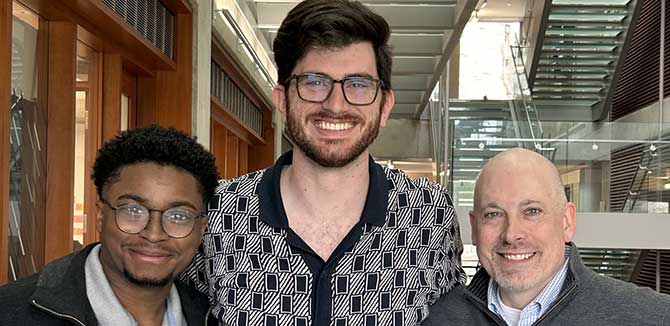
Kelechi Achilefu (mpd² '26), Steve Chamberlain (mpd² '26), and Ian Richards (mpd² '26) partnered with Fortune Brands Innovations, whose subsidiaries include a collection of security brands such as Master Lock and Yale.
Their mission: Understand where there was opportunity for lockbox growth.
“They were looking at expanding offerings to capture a greater share of the smartlock space and (understand) how lockboxes integrate into that,” Steve said. “We took that project and did our own research to understand not only the landscape but also look at its specific target.”
Their determination was a pivot from perhaps a lockbox’s most prominent users—realtors—to property managers, who are the ones most commonly frustrated when a key wanders away from its home.
The solution: A connected lockbox system that pairs a lockbox with a fob and an app that communicates with each other to ensure the key doesn't disappear. If the fob that allows entrance doesn’t make its way back to its lockbox home, the property manager is immediately notified via the app so the situation can be rectified before it causes downstream business problems.
“Overall, it was a way to reduce and remove that burden that property managers typically find when that key does go missing and being sure that the friction of interacting with the lockbox is minimized,” Kelechi said. “This was a great experience, especially because we had stakeholders that we could talk to and evaluate our ideas.”
The life of a property manager can be a challenging one, the students learned through more than 30 hours of interviews.
Codes for locks can easily be shared by contractors or renters with those who shouldn’t have access. Lockboxes are occasionally tampered with, pried open, or stolen. In multi-family buildings, placing dozens of lockboxes on the same fence can sometimes lead to them being cut off by building management
But most prominently, keys left in lockboxes have a nasty habit of wandering away, leading not only to the expense of creating another key but also negative business opportunities, including
- Potential renters or buyers who come to see a place but can’t get in and quickly move onto other apartments or houses.
- Contractors who show up to do work but who can’t get in and who then bill for their lost time.
- Cleaning crews who are unable to access the property and leave a less-than-spectacular place for the next renters.
“One of the things they kept saying was, ‘I really wish you could just put a string on the key so that (people) can't leave it where they're not supposed to,’” Ian said. “So we did a lot of brainstorming around what's a string but not a string. How do we keep the keys where they're supposed to be?”
That idea is now working its way through the US patent system. Fortune Brands identified that what the students proposed could be valuable intellectual property that they wanted to keep out of competitors’ innovation labs.
The students played an integral role in reviewing the application before it was submitted. If it is approved, the trio will be credited as inventors.
The capstone experience showed the strength of the mpd² program, the students said. Though their capstone course is done, the three continue to work with Fortune Brands to perfect their creation.
“It's indicative of the quality of thinking and the quality of work that the program coaches us for,” Ian said. “It expects that the solutions students come up with in this program are something novel, unique in the space, and leads to something like a patent.”
It also reflects the immediate applicability of what the program teaches.
“A lot of the program’s marketing material focuses on learning something on Saturday and applying it on Monday, and they really hit the nail on the head with that one,” Ian said. “You learn something on Saturday, and by Monday you're sitting at your desk at work going, ‘Oh yeah, that does apply here.”